Published on April 20, 2026
Effects of house leakage on ventilation
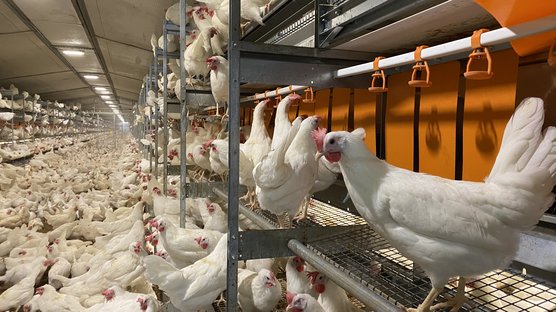
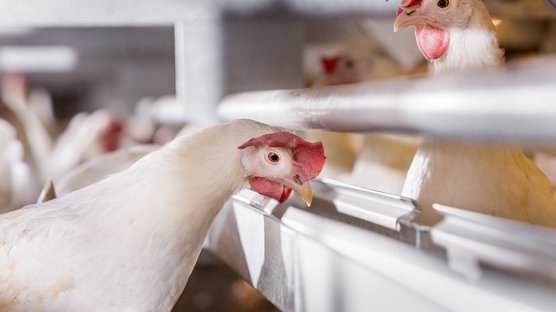
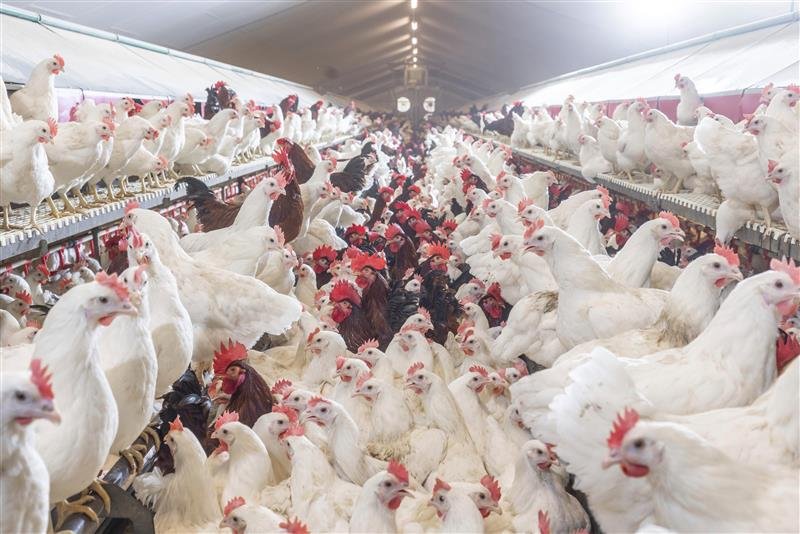
Ventilation in a poultry layer shed is the essential process of exchanging stale indoor air with fresh outside air to maintain a healthy environment for egg-laying hens. It functions as the "lungs" of the house, regulating temperature, humidity, and air quality to ensure optimal welfare and egg production.
Ventilation is primarily used to control indoor air quality by diluting and displacing pollutants. Important parameters of good-quality air are included:
| Parameter | Ideal Value | Maximum Limit |
|---|---|---|
| Ammonia (NH₃) | < 10 ppm | 20–25 ppm |
| Carbon Dioxide (CO₂) | < 2,500 ppm | 3,000–3,500 ppm |
| Dust Level | Minimal, not visible | — |
| Relative Humidity (RH) | 50–70% | >75% harmful |
| Temperature (Layers) | 18–24°C | >30°C heat stress |
| Oxygen (O₂) | 20–21% | <19% poor air |
In a properly sealed poultry house, fresh air enters through designed inlets during minimum ventilation. It travels along the ceiling, mixes uniformly with warm air, and is exhausted by the fans. The process is regulated by static pressure, which depends on several variable factors.
Recommended static pressure levels
- Cold Weather: A (higher) pressure of 25 to 38 Pa is recommended. This creates air speeds of approximately 4.5 to 7.5 m/sec, allowing that cold, heavy air to reach the center of the house to mix with warm air before descending towards the chickens.
- Warm Weather: A lower pressure of 11 to 25 Pa is adequate when the temperature difference between inside and outside is less than 11°C (20°F).
- House Width:
- Houses wider than 15m (50ft): Aim for 25 to 30 Pa
- Houses narrower than 15m (50ft): Aim for 20 to 25 Pa
Key Performance Indicators
- Air Throw (Rule of Thumb): For every 2.5 Pa of static pressure, incoming air travels approximately 0.6 meters (2 ft).
- House Sealing Test: To ensure sufficient tightness for effective minimum ventilation, a poultry house should achieve a static pressure of at least 37.5 Pa with all inlets closed and fans are running at 1 cfm/ft². New, well-constructed houses should reach 60 Pa.
- Minimum Inlet Opening: Inlets should typically be open 2.5 to 5 cm (1 to 2 inches) to maintain proper pressure without restricting airflow.
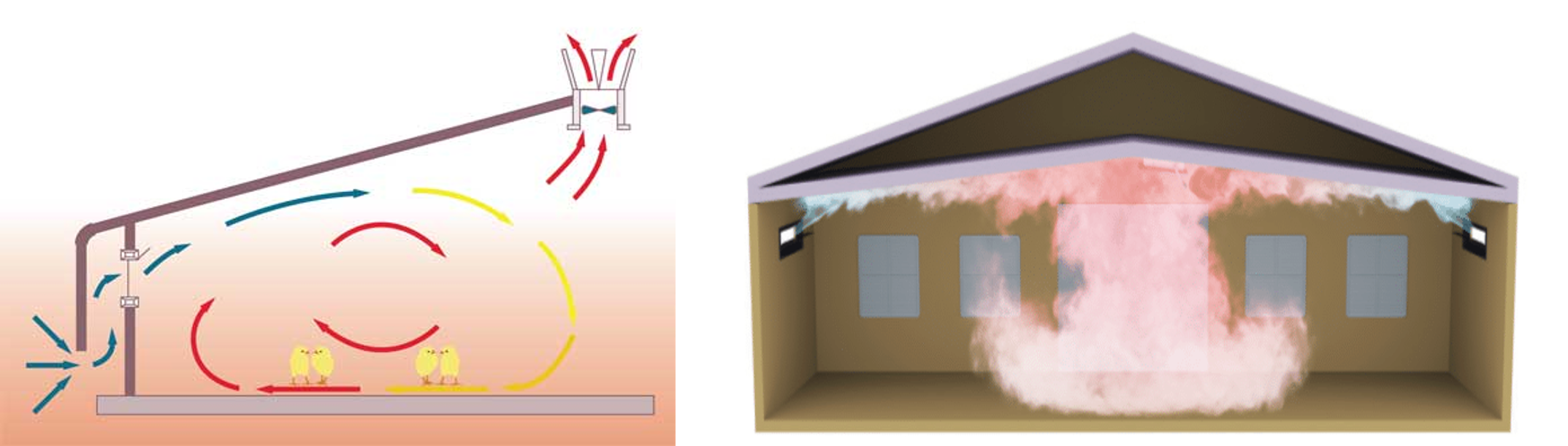
Figure: Effect of correct static pressure during minimum ventilation.
Airflow Behavior Under Correct Static Pressure
Air entering through properly designed sidewall inlets attaches to the ceiling, travels toward the center of the poultry house, and gently descends toward the floor. Maximizing this ceiling travel is essential so that cool incoming air warms adequately before reaching the chickens.
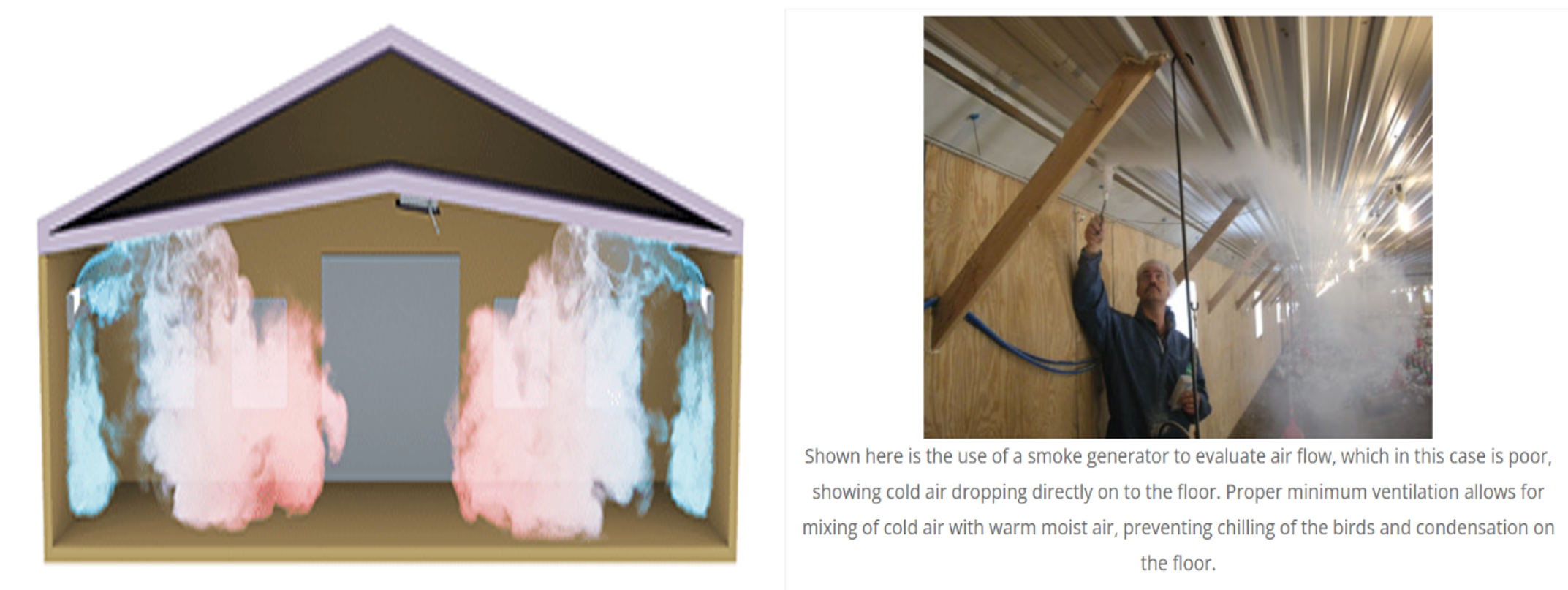
Figure: cold air blowing to the baby chicks/birds due to in-correct static pressure.
Airflow Problems Under Incorrect Static Pressure
The mixing of the cool, damp air with the warm air at the top of the house is only possible when the air enters the shed at correct static pressure. If static pressure is too low, the cool incoming air falls prematurely, reaching the birds before proper mixing. This results in chilling of the chickens and uneven temperatures.
Impact of House Leakage
Any unplanned leakage significantly reduces static pressure and ventilation efficiency. Even small opening (around shutters, doors, cracks, or curtains) allow cold, damp air to enter directly. This uncontrolled air:
- drops quickly to the floor
- chills the birds
- increases litter moisture and condensation
- reduces the system’s ability to remove humidity
Common leakage sources and impacts
| Leakage Source | Location |
Ventilation Impact |
Resulting Problem |
|---|---|---|---|
| Door gaps |
Main & emergency doors |
Uncontrolled air entry |
Drafts, temperature fluctuation |
|
Curtain leakage |
Sidewalls |
Bypasses inlets |
Poor air mixing |
| Fan shutter gaps | Exhaust fans | Air backflow |
Reduced fan efficiency |
|
Roof cracks |
Roof joints |
Heat loss |
Cold stress in winter/ Heat stress in summer |
| Cable/pipe holes |
Walls & ceiling |
Air short-circuiting |
Dead air zones |
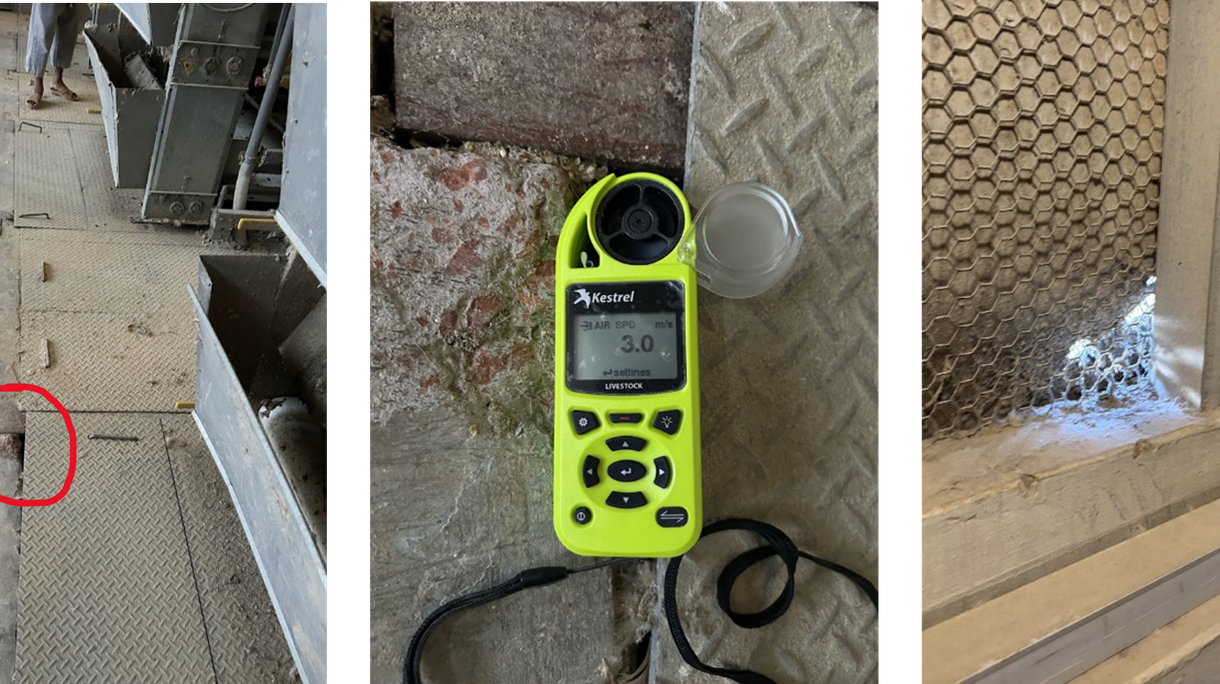
Figure: practical situation of house leakage and their outcome
Leakage not only affects minimum ventilation, it also has a significant impact on tunnel ventilation. At higher airspeeds, even small leaks allow large volumes of air to escape, providing no benefit to the chickens.
Key effects of house leakage
- Reduced ventilation efficiency
- Poor temperature and humidity control
- Increased ammonia and CO₂ levels
- Higher electricity consumption
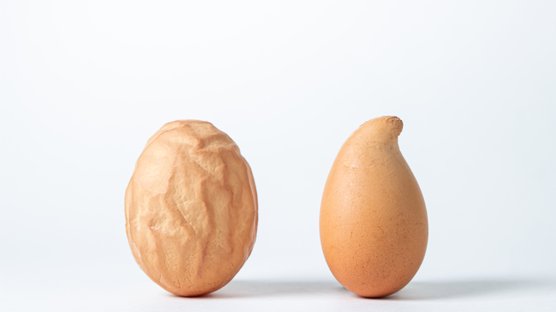
- Reduced egg production and shell quality
Inspection checklist for leakage control
- Inspect doors, curtains, and access panels for gaps
- Check fan shutters and backdraft dampers for proper sealing
- Seal cracks in walls, roof sheets, and ridge joints
- Ensure air inlets close fully when fans are off
- Inspect cable, pipe, and water line entry points
- Conduct a smoke test to identify hidden air leaks
- Monitor static pressure regularly with a manometer
- Repair damaged insulation and worn rubber seals
- Perform inspection before winter and summer seasons
- Maintain written records of leakage inspection and repairs
House leakage is often an hidden but serious issue that undermines ventilation performance. Regular inspection, sealing, and maintenance are essential to protect bird welfare and optimize productivity in layer farms. The tighter the house, the more control the chicken farmer has over the entire ventilation system.