Published on May 19, 2026
From Egg to Chick: how good hatching egg management impacts chick quality
In the egg industry, everyone recognizes that chick quality influences greatly the potential of the flock during their productive lifetime. What is sometimes underestimated is how early that quality is shaped. Before a day-old chick reaches a pullet farm, long before the hatching egg even enters the hatchery, there are many small decisions and handling steps that can influence whether that chick will be strong, part of a uniform flock, and capable of reaching its full genetic potential.
It should not be forgotten that hatching eggs are living creatures. They respond to temperature, movement, hygiene, and time. They carry the biological foundation of the next flock, and they are surprisingly sensitive. That is why professional hatching egg management matters so much. What happens during the hours, days, and sometimes weeks between laying and setting can dramatically influence commercial chick performance, for better or for worse.
Healthy breeder flocks are at the start of every good chick. Good chicks come from good quality hatching eggs, and good quality hatching eggs come from well‑managed breeder flocks. Even the most advanced hatchery cannot correct an hatching egg that is compromised at the biological level. The genetic potential is only fully expressed when the breeder flocks are in excellent condition, well nourished, and well managed. As stated, chick quality begins with the physiological condition of the breeder flock, and managing that flock correctly requires a high‑level understanding of reproductive biology, uniformity control, and environmental stability. Breeders must enter lay with a well‑developed skeletal frame and a balanced body composition. Achieving this depends on high quality pullet rearing, including body‑weight curves, flock uniformity thresholds, and the timing and precision of light stimulation to synchronise sexual maturation. During the production phase, nutrient density and feed structure are adjusted to maintain eggshell strength while avoiding excessive body‑weight gain that can reduce fertility. Male management plays an equally important role: correct male-to-female ratios, physical conditioning, and regular male grading help maintain stable mating activity and reduce the decline in fertility later in lay. Breeder houses must offer controlled climate, good litter quality, and low-stress conditions, as any deviation (heat stress, sudden noise, competition at feeders) can influence hormone balance and directly reduce ovulation quality or mating success. When these breeder‑specific management points are executed to our high standards, the hatching eggs produced carry a strong embryo, high internal stability, and a structure capable of withstanding transport, storage, and incubation.
Once an egg is laid, the countdown begins. Its temperature drops, the shell surface interacts with the environment, moisture begins to evaporate, and microbes in the surrounding area try to find their way inside. Every hour the egg remains in the aviary or nest area increases the risk of contamination, hairline cracking, or unplanned temperature swings. Timely and gentle egg collection reduces these risks dramatically.
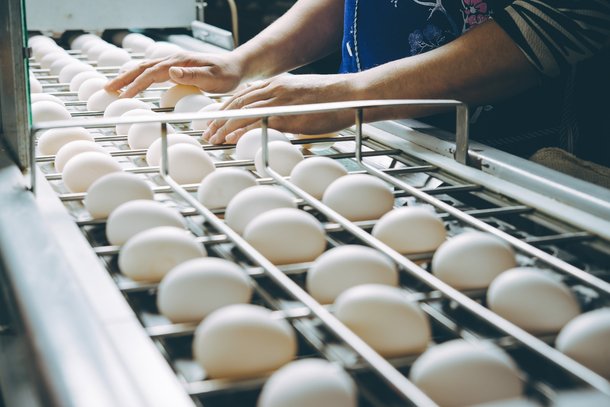
Egg handling is one of the most underestimated stages of the chain. While cracked eggs are easy to spot, micro‑cracks are not. A hairline crack invisible to the eye can allow bacteria to enter the hatching egg, or cause excess evaporation during storage. Professional egg trays, shock‑absorbing floors, correct stacking height, and well‑adjusted lifters and conveyors all serve to protect the eggshell.
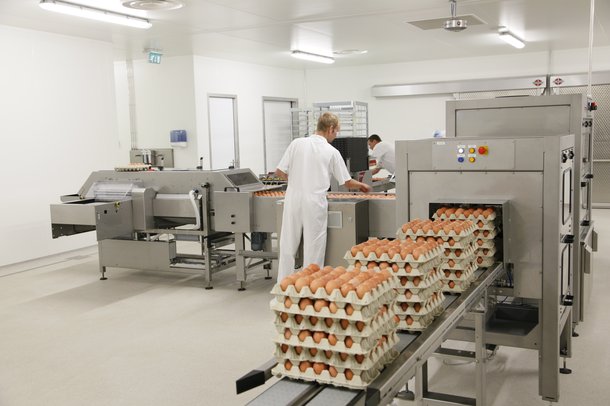
Storage is not simply a waiting period; it is a biological control phase. Embryos are paused in development, and the quality of that pause determines how uniformly they will develop once incubation begins. Temperature, humidity, and time are the key variables. If storage is too warm, the embryo may begin to develop prematurely. If too cold, it can become chilled and lose viability.
Transport is another moment of vulnerability for hatching eggs. Vibration, long waiting times, rough handling, or poorly controlled temperatures can undo a lot of good work done on the farm. Using climate‑controlled vehicles, maintaining stable trolley systems, ensuring correct stacking, and planning routes that minimize delays all help maintain egg quality.
Before eggs are set, they must be brought gradually from storage temperature to incubation temperature. A consistent pre‑warming program helps the embryo restart smoothly, reduces condensation, and contributes to a tighter hatch window. A narrow hatch window means that chicks are more uniform in development when they enter the chick‑handling process.
Modern incubation equipment is highly sophisticated, but even the best machines cannot fully correct for eggs that have been mishandled or stored too long. When eggs arrive at the hatchery with strong biological quality and good internal stability, incubators can do what they are designed to do: guide embryos through controlled temperature increase, moisture loss, gas exchange, and turning cycles.
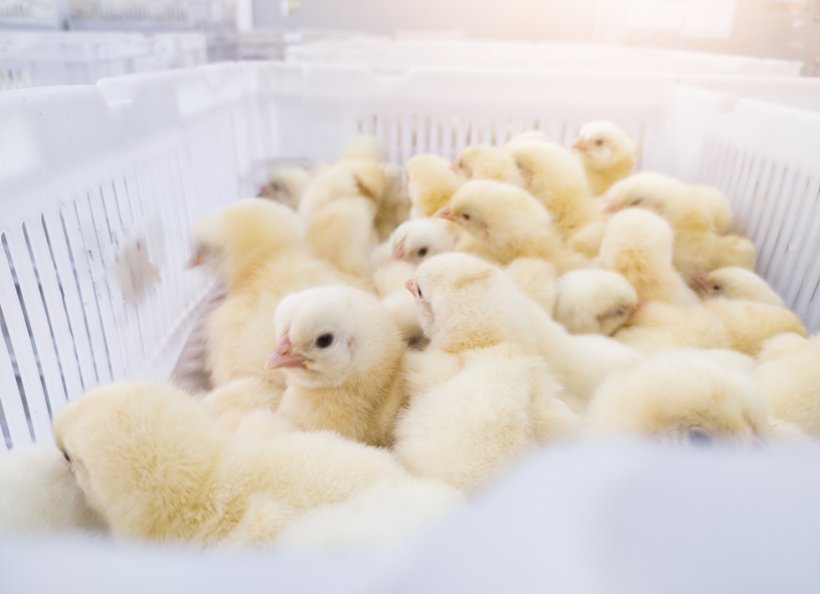
Chick quality is ultimately seen in the chick itself; its activity, its hydration, its yolk absorption, its leg condition, and its overall robustness. Chicks that hatch from well‑managed hatching eggs tend to be more uniform and have higher viability, which directly supports lower first‑week mortality and better early growth in rearing.
Across our operations, hatching egg management is treated as a discipline, and not just a checklist. We audit all our farms and hatcheries, train staff, refine handling procedures, calibrate equipment, and support decision‑making with biological data. The goal is simple: to protect the potential of every embryo and ensure that our customers receive chicks that are strong, uniform, and ready to perform and show their true genetic potential!